How did the Navier–Stokes equations become the second Millennium Prize Problem to approach a breakthrough?
Why ask for a proof? Because a proof gives not only certitude, but also understanding. - Clay Mathematics Institute - The Millennium Prize Problems — Navier-Stokes Equation
A fundamental problem in analysis is to decide whether such smooth, physically reasonable solutions exist for the Navier–Stokes equations. To give reasonable leeway to solvers while retaining the heart of the problem, we ask for a proof of one of the following four statements.
(A) Existence and smoothness of Navier–Stokes solutions on \( \mathbf{\mathbb{R^3}} \).
(B) Existence and smoothness of Navier–Stokes solutions on \( \mathbf{\mathbb{R^3/Z^3}} \).
(C) Breakdown of Navier–Stokes solutions on \( \mathbf{\mathbb{R^3}} \).
(D) Breakdown of Navier–Stokes Solutions on \( \mathbf{\mathbb{R^3/Z^3}} \).
– Existence And Smoothness Of The Navier–Stokes Equation, Official Problem Description by Charles L. Fefferman
Fluids are important and hard to understand. There are many fascinating problems and conjectures about the behavior of solutions of the Euler and Navier–Stokes equations. Since we don’t even know whether these solutions exist, our understanding is at a very primitive level. Standard methods from PDE appear inadequate to settle the problem. Instead, we probably need some deep, new ideas. - Existence And Smoothness Of The Navier–Stokes Equation, Official Problem Description by Charles L. Fefferman
1738 Daniel Bernoulli’s Hydrodynamica (relates fluid flow to pressure).
\( \displaystyle \huge p + \frac{1}{2}\rho v^2 + \rho gh = \text{constant} \)
Daniel Bernoulli was primarily a physicist.

Bernoulli’s principle can be used to calculate the lift force on an airfoil, if the behaviour of the fluid flow in the vicinity of the foil is known. For example, if the air flowing past the top surface of an aircraft wing is moving faster than the air flowing past the bottom surface, then Bernoulli’s principle implies that the pressure on the surfaces of the wing will be lower above than below. This pressure difference results in an upwards lifting force. Whenever the distribution of speed past the top and bottom surfaces of a wing is known, the lift forces can be calculated (to a good approximation) using Bernoulli’s equations, which were established by Bernoulli over a century before the first man-made wings were used for the purpose of flight.

Commercially available Bernoulli grips are commonly used to handle rigid sheet like material such as silicon wafers in circuit board manufacturing, or photovoltaic cell components.
1757 Euler’s “Principes généraux du mouvement des fluides” (Euler equations, start of
modern hydrodynamics).
\(
\displaystyle \huge
\begin{aligned}
\frac{\partial \mathbf{u}}{\partial t} + (\mathbf{u} \cdot \nabla)\mathbf{u} &= -\frac{1}{\rho}\nabla p + \mathbf{f} \\
\nabla \cdot \mathbf{u} &= 0
\end{aligned}
\)
This makes it quite clear how far removed we are from a complete understanding of the motion of fluids and that my exposition is no more than a mere beginning. Nevertheless, everything that the Theory of Fluids contains is embodied in the two equations formulated above, so that it is not the laws of Mechanics that we lack in order to pursue this research but only the Analysis, which has not yet been sufficiently developed for this purpose. It is therefore clearly apparent what discoveries we still need to make in this branch of Science before we can arrive at a more perfect Theory of the motion of fluids. - Leonhard Euler
Indeed, it is notoriously hard to perform a reliable numerical simulation of the 3D Euler equations.
1823 Navier formulates equations now known as the Navier–Stokes equations.
\(
\displaystyle \huge
\begin{align}
\rho \left( \frac{\partial \mathbf{u}}{\partial t} + (\mathbf{u} \cdot \nabla)\mathbf{u} \right) &= -\nabla p + \mu \nabla^2 \mathbf{u} + \mathbf{f} \\
\nabla \cdot \mathbf{u} &= 0
\end{align}
\)
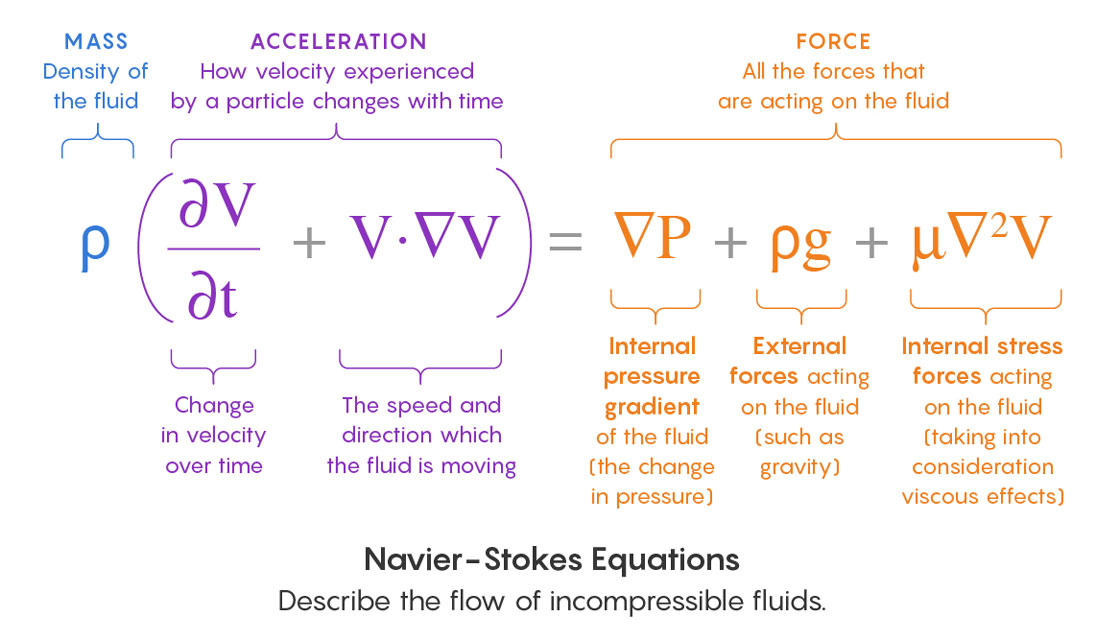
The Navier–Stokes equations agree very well with experiments on real fluids under many and varied circumstances. Since fluids are important, so are the Navier–Stokes equations.
In principle the Navier–Stokes equations provide a complete and very accurate theory of lift, but practical prediction of lift requires that the effects of turbulence be modeled in the Reynolds-averaged Navier–Stokes equations rather than computed directly.
The character of the equation … changes simultaneously in all relevant respects: Both order and degree change. Hence bad mathematical difficulties must be expected. — John von Neumann
However, numerical and physical experiments suggest strongly that this is not the case. Instead, it seems that there exists \( T_0 > 0 \), depending on \( u^{0} \) but independent of \( ν \), such that the fluid loses at least half of its initial energy by time \( T_0 \), regardless of how small \( ν \) is (provided that \( ν > 0 \) ). We need to understand why a tiny viscosity dissipates a lot of energy.
The fundamental basis of almost all computational fluid dynamics problems is the Navier–Stokes equations.
CFD is applied to a range of research and engineering problems in multiple fields of study and industries, including aerodynamics and aerospace analysis, hypersonics, weather simulation, natural science and environmental engineering, industrial system design and analysis, biological engineering, fluid flows and heat transfer, engine and combustion analysis, and visual effects for film and games.
1883 Osborne Reynolds demonstrated Laminar–turbulent transition


1904 Ludwig Prandtl described the boundary layer and its importance for drag and streamlining.

1934 Jean Leray published an important paper that founded the study of weak solutions of the Navier–Stokes equations.
A promising idea, pioneered by J. Leray in the 1930s, is to study “weak solutions” of the Navier–Stokes equations.
A long-established idea in analysis is to prove existence and regularity of solutions of a PDE by first constructing a weak solution, then showing that any weak solution is smooth. This program has been tried for Navier–Stokes with partial success.
It has been known for a long time how to construct suitable weak solutions of 3D Navier–Stokes, but the uniqueness of these solutions has not been proved.
The global regularity problem for Navier-Stokes asks for existence of global smooth solutions to a Cauchy problem for a nonlinear PDE.
The standard response to this question is turbulence – the behaviour of three-dimensional Navier-Stokes equations at fine scales is much more nonlinear (and hence unstable) than at coarse scales. I would phrase the obstruction slightly differently, as supercriticality. Or more precisely, all of the globally controlled quantities for Navier-Stokes evolution which we are aware of (and we are not aware of very many) are either supercritical with respect to scaling, which means that they are much weaker at controlling fine-scale behaviour than controlling coarse-scale behaviour, or they are non-coercive, which means that they do not really control the solution at all, either at coarse scales or at fine.
In conclusion, while it is good to occasionally have a crack at impossible problems, just to try one’s luck, I would personally spend much more of my time on other, more tractable PDE problems than the Clay prize problem, though one should certainly keep that problem in mind if, in the course on working on other problems, one indeed does stumble upon something that smells like a breakthrough in Strategy 1, 2, or 3 above. (In particular, there are many other serious and interesting questions in fluid equations that are not anywhere near as difficult as global regularity for Navier-Stokes, but still highly worthwhile to resolve.) - Why global regularity for Navier-Stokes is hard, by Terence Tao, March 18, 2007
Most mathematicians have concentrated their energy on trying to prove that the solutions to the Navier-Stokes equations remain smooth and well-behaved forever, a property called global regularity. Purported proofs of global regularity surface every few months, but so far each one has had a fatal flaw[1] [2].
Tao’s ideas certainly aren’t standard, Friedlander said. “But results about global regularity, whether positive or negative, will almost certainly require something that is nonstandard.” Tao’s ideas are quite likely to lead to some interesting mathematics, she said, whether or not they answer the Navier-Stokes question.
Meanwhile, Tao’s new program for tackling Navier-Stokes has changed his thinking about the problem. Previously, he had viewed both sides of the problem — proving global regularity or establishing that solutions can blow up — as equally remote goals (though in the end, only one can be true). Now he believes that it should be possible to concoct special scenarios in which a solution to the Navier-Stokes equations blows up. (This wouldn’t mean that the real ocean could blow up — instead, it would suggest that in these rare cases, the Navier-Stokes equations don’t fully capture the ocean’s physics.) “My mindset has certainly changed,” he said. - A Fluid New Path in Grand Math Challenge, by Erica Klarreich , February 24, 2014
[1] Mukhtarbay Otelbaev, Prof. Dr., Academician of the NAS of the RK, Director of the Eurasian Mathematical Institute of L.N. Gumilyov Eurasian National University, completed and published paper “Existence of a strong solution of the Navier-Stokes equations” in the press.
Mukhtarbay Otelbaev is the winner of the title “Man of Science of the Year” in contest “Altyn Adam” (“Man of the Year in Kazakhstan “ in the category “Science”) 2002; in 2002-2003, 2004 – 2005 is the Winner of the state scientific grant for scientists and experts who have made outstanding contributions to the development of science and technology, winner of the Economic Cooperation Organization in the “Science and Technology“, 2004, winner of the MES grant of the RK “Best university teacher”, laureate of the State Prize of the Republic Kazakhstan in the field of science and technology.
[2] In 2014, about the decision of the sixth problem of the Millennium was announced by the author mukhtarbai Otelbayev from the Eurasian national University named after Lev Gumilev (Kazakhstan). American mathematician Terence Tao found counterexamples to refute the decision of the Kazakhstan scientist.
While physicists consider the equations to be as reliable as a hammer, mathematicians eye them warily. To a mathematician, it means little that the equations appear to work. They want proof that the equations are unfailing: that no matter the fluid, and no matter how far into the future you forecast its flow, the mathematics of the equations will still hold. Such a guarantee has proved elusive.
under certain assumptions, the Navier-Stokes equations provide inconsistent descriptions of the physical world.
“We’re figuring out some of the inherent issues with these equations and why it’s quite possible that people have to rethink them,” said Buckmaster.
Mathematicians model that interplay using a map that tells you the direction and magnitude of the current at every position in the fluid. This map, which is called a vector field, is a snapshot of the internal dynamics of a fluid. The Navier-Stokes equations take that snapshot and play it forward, telling you exactly what the vector field will look like at every subsequent moment in time.
The equations work. They describe fluid flows as reliably as Newton’s equations predict the future positions of the planets; physicists employ them all the time, and they’ve consistently matched experimental results. Mathematicians, however, want more than anecdotal confirmation — they want proof that the equations are inviolate, that no matter what vector field you start with, and no matter how far into the future you play it, the equations always give you a unique new vector field.
This is the subject of the Millennium Prize problem, which asks whether the Navier-Stokes equations have solutions (where solutions are in essence a vector field) for all starting points for all moments in time. These solutions have to provide the exact direction and magnitude of the current at every point in the fluid. Solutions that provide information at such infinitely fine resolution are called “smooth” solutions. With a smooth solution, every point in the field has an associated vector that allows you to travel “smoothly” over the field without ever getting stuck at a point that has no vector — a point from which you don’t know where to move next.
Smooth solutions are a complete representation of the physical world, but mathematically speaking, they may not always exist. Mathematicians who work on equations like Navier-Stokes worry about this kind of scenario: You’re running the Navier-Stokes equations and observing how a vector field changes. After some finite amount of time, the equations tell you a particle in the fluid is moving infinitely fast. That would be a problem. The equations involve measuring changes in properties like pressure, friction, and velocity in the fluid — in the jargon, they take “derivatives” of these quantities — but you can’t take the derivative of an infinite value any more than you can divide by zero. So if the equations produce an infinite value, you can say they’ve broken down, or “blown up.” They can no longer describe subsequent states of your fluid.
Blowup is also a strong hint that your equations are missing something about the physical world they’re supposed to describe. “Maybe the equation is not capturing all the effects of the real fluid because in a real fluid we don’t expect” particles to ever start moving infinitely fast, said Buckmaster.
In 1934 the French mathematician Jean Leray defined an important class of weak solutions. Rather than working with exact vectors, “Leray solutions” take the average value of vectors in small neighborhoods of the vector field. Leray proved that it’s always possible to solve the Navier-Stokes equations when you allow your solutions to take this particular form. In other words, Leray solutions never blow up.
Buckmaster and Vicol prove the existence of many nonunique weak solutions to the Navier-Stokes equations. - Mathematicians Find Wrinkle in Famed Fluid Equations, by Kevin Hartnett, December 21, 2017
Why are these equations, which describe familiar phenomena such as water flowing through a hose, so much harder to understand mathematically than, say, Einstein’s field equations, which involve stupefying objects like black holes? The answer, I discovered, is turbulence. It’s something we’ve all experienced, whether flying through choppy air at 30,000 feet or watching a whirlpool gather in the bathtub drain. Yet familiarity hasn’t bred knowledge: Turbulence is one of the least understood parts of the physical world.
Mathematicians worry about this kind of scenario: You’re running the equations, and after some finite amount of time, they tell you a particle in the fluid is moving infinitely fast. That would be a problem because you can’t calculate the change of an infinite value any more than you can divide by zero. Mathematicians refer to such scenarios as “blowup,” and in a blowup scenario you’d say the equations break down and solutions don’t exist. - What Makes the Hardest Equations in Physics So Difficult?, by Kevin Hartnett, January 16, 2018
For centuries, mathematicians have sought to understand and model the motion of fluids. The equations that describe how ripples crease the surface of a pond have also helped researchers to predict the weather, design better airplanes, and characterize how blood flows through the circulatory system. These equations are deceptively simple when written in the right mathematical language. However, their solutions are so complex that making sense of even basic questions about them can be prohibitively difficult.
Perhaps the oldest and most prominent of these equations, formulated by Leonhard Euler more than 250 years ago, describe the flow of an ideal, incompressible fluid: a fluid with no viscosity, or internal friction, that cannot be forced into a smaller volume. “Almost all nonlinear fluid equations are kind of derived from the Euler equations,” said Tarek Elgindi, a mathematician at Duke University. “They’re the first ones, you could say.”
“It’s an amazing result,” said Tristan Buckmaster, a mathematician at the University of Maryland who was not involved in the work. “There are no results of its kind in the literature.”
The 177-page proof — the result of a decade-long research program — makes significant use of computers. This arguably makes it difficult for other mathematicians to verify it. (In fact, they are still in the process of doing so, though many experts believe the new work will turn out to be correct.) It also forces them to reckon with philosophical questions about what a “proof” is, and what it will mean if the only viable way to solve such important questions going forward is with the help of computers.
Perhaps in some situations, the equations will proceed as expected, producing precise values for the state of the fluid at any given moment, only for one of those values to suddenly skyrocket to infinity. At that point, the Euler equations are said to give rise to a “singularity” — or, more dramatically, to “blow up.”
These efforts mark a growing trend in the field of fluid dynamics: the use of computers to solve important problems.
But in fluid mechanics, computer-assisted proofs are still a relatively new technique. In fact, when it comes to statements about singularity formation, Hou and Chen’s proof is the first of its kind: Previous computer-assisted proofs were only able to tackle toy problems in the area. - Computer Proof ‘Blows Up’ Centuries-Old Fluid Equations, by Jordana Cepelewicz, November 16, 2022
And for nearly 200 years, the Navier-Stokes equations have served as an unimpeachable theory of how fluids in the real world behave — from ocean currents threading their way between the continents to air wrapping around an aircraft’s wings.
In these realistic theories, “a lot of people believe that there are singularities, but that they are unstable, so we never see them,” said Charlie Fefferman, a mathematician at Princeton University who formulated the million-dollar Navier-Stokes challenge.
“The graveyards are strewn with alleged singular solutions of 3D Euler,” Fefferman said. - Using AI, Mathematicians Find Hidden Glitches in Fluid Equations, by Charlie Wood, January 9, 2026
The Navier-Stokes equations presume that fluids are continuous substances that flow perfectly smoothly, no matter how much you zoom in on a point. But in fact, fluids are amalgamations of molecules and atoms. As you zoom in, you’ll eventually discern tiny blips in the flow due to this grainy nature, blips that the classic fluid equations lop off.
“Navier-Stokes is very much an approximation,” said Michael Landry, a physicist at the Massachusetts Institute of Technology. “It’s not an exact equation.”
They realized you could always swap two parcels of a fluid for free. You could also shuffle three parcels, or four, or any number. In contrast, you can’t exchange any regions of a solid without paying an energy toll, through rupture or serious internal stress, so solids lack these swapping symmetries.
A fluid is any material with a particular set of symmetries, no matter what it’s made of. - Theory of Fluids Enters the 21st Century, by Charlie Wood, August 17, 2026
“I was thrilled that the problem was solved,” said Charles Fefferman of Princeton University, who wrote the Clay Institute’s official description of the Navier-Stokes problem. The heroes of the story, he said, are Córdoba and Martínez-Zoroa.
Turbulence is even weirder than it appears to be.
“Ten years ago, nobody believed there was a singularity for Navier-Stokes,” said Córdoba — though many believed that the Euler equations did admit a singularity. This began to change in 2013, when Thomas Hou of the California Institute of Technology and Guo Luo, now at the Hang Seng University of Hong Kong, derived a groundbreaking result showing that the Euler equations can “blow up,” as mathematicians like to say, in a cylinder if the top and bottom halves are set spinning in opposite directions. “That’s the first really serious claim of singularity,” Córdoba remembered.
In their 2013 cylinder result, Hou and Luo used computer models to simulate a scenario that might lead the Euler equations to blow up. They then proved that blowup does occur by computationally accounting for all potential errors. In the years since, similar techniques have become the dominant mode of attack on the Euler and Navier-Stokes problems.
But in his 2021 doctoral dissertation, Martínez-Zoroa pioneered analytic techniques that don’t rely on computers at all. This made him, along with Córdoba, his doctoral adviser, an oddball in the area. By 2023, the pair had proved that a version of the Euler equations with a messy forcing function displayed singularities.
In broad outline, the pair’s technique relies on creating an infinite sequence of “layers,” each of which is a non-singular solution to the equation they are studying. (They’ve applied similar techniques to both the Euler and Navier-Stokes equations, as well as to other related systems.) They then combine those solutions in what Martínez-Zoroa calls an “infinite cascade” to produce a new solution. - AI Has Solved One of Math’s $1 Million Millennium Prize Problems, by Konstantin Kakaes, September 8, 2026
Martin Hairer talks with Tom Crawford: I remember last year in Oxford. I mean, I guess you were there. There was this workshop for the 25 years of the millennium problems. Yes. And it was very clear that the Navier-Stokes one was the one that was sort of in the end sprint, right? - Navier-Stokes, AI and the Future of Mathematics with Martin Hairer, Sep 20, 2026
- The number of problems that have been solved is one more than I would expect. - Manjul Bhargava
- Some problems, the tools are not there. You have to wait until there’s some sort of breakthrough… - Terence Tao
- “Knowledge is power,” or so the adage goes. But understanding is more powerful power. But understanding is still kept a secret, at least in mathematics. - How to Bake Pi, by Eugenia Cheng
- AI models skip to the end. At the moment, their proofs are nearly impossible to read. They elide salient details and waste pages on irrelevant concepts. They fail to demonstrate how the new work builds on or connects to other results in the mathematical literature. Mathematicians know that the proofs are true — they’re verified by a system that checks their logic — but have no idea why. What’s missing is understanding, the currency that mathematicians trade in. Mathematicians have always known that understanding is more valuable than an answer. - Is AI the End of Math As We Know It?, by Jordana Cepelewicz