My Monthly Digest List - April - 2026

Positive.News

Issue 124 / January-March 2026

Romania’s recycling revolution lifts off

A deposit return scheme for drink bottles and cans in Romania has proved a game-changer, with an astonishing 94% of containers now recycled

“You go to Romania now, you don’t see a bottle anywhere”, said RetuRo CEO Gemma Webb. “It was the impossible made possible. Everybody’s very proud”.

China’s emissions flatline amid solar boom

Crop yields soar thanks to solar panels

solar can boost harvests rather than hinder them.

inventive teens will always find ways to dodge the ban.

Waterloo Region Record

Monday, April 20, 2026

Researchers find traces of opioids in Ontario fish population

Drugs like fentanyl, methadone and antidepressants are showing up in freshwater fish


PM lands on Time’s most influential people list

his frequent nickname in the banking world, “George Clooney of finance”

Wednesday, April 8, 2026

‘Waddleloo’ map offers students safe passage from nesting geese

University of Waterloo student Anirudh Dabas created Waddleloo to help students navigate areas where geese have been spotted. He likens the birds to an “unofficial final boss.”

Opinion

What will it be like when Premier Ford’s regional chair doesn’t care what you think?

Luisa D’Amato

Ford has consolidated and expanded his influence to the point that Ontario has become a kind of flawed democracy, with no balance of power

51st-state talk gets put on ice — for now

Donald Trump’s views on Canadian sovereignty appear to be constantly in motion, weaving back and forth like his social media feed.

Thanks to a British author, we learned this week that all the 5lst-state talk is now on the back burner for two reasons: one lies in Trump’s respect for King Charles, and, maybe more significantly, the president doesn’t have enough time to annex this nation. In a book excerpt published in the U.K. by the Daily Mail, author and royalty expert Robert Hardman recounts a conversation he had with Trump late last year.

It’s worth pausing here to flag a couple of things. If this really was the first time Trump had reflected on the monarchy’s status in Canada, he missed some large signals sent last year. Most notably, King Charles read the throne speech last May and politely underlined that Canada was to remain “the true north, strong and free.” That was largely interpreted as the King telling Trump to cut it out on the annexation talk. Perhaps Trump wasn’t listening that day.
Similarly, perhaps the president’s attention was elsewhere when King Charles made a flurry of symbolic gestures in the months after the 5lst-state talk seemed to be on the rise - planting a Canadian maple tree at Buckingham Palace, for instance.

So maybe Canada can thank Hardman for reminding Trump that when he threatens Canada, he threatens the British monar-hy he so admires. But it should be also pointed out that the resident has not stopped taunting Carney as the “future gover-or of Canada,” which he did as recently as last month, a good few onths after he talked to Hardman.

Thursday, April 2, 2026

Mac to the future

Apple’s 50-year odyssey has redefined technology, pop culture and comeback stories

by Michael Liedtke

A scrawny hippie and a nerdy engineer who became prank-playing friends vowed to change the world when they founded a Silicon Valley startup on April Fools’ Day 50 years ago and then - no joke - pulled it off.

Eye on the area photos

Trumpeter Swan - It’s beautiful when you go on a trail walk and get a surprise seeing over 20 trumpeters swans at Mill Pond in Cambridge.

Holy Bible

Origin of the Bible

No book in the history of the world has wielded as much influence on civilization as the Holy Bible. The Bible is unique in that it had God as its Author, while all other books were composed by human beings. It is indeed, the Book of Books.

The End Of The Certain World

by Nancy Thorndike Greenspan

p12

“The loveliest feast” of the year was Christmas, complete with presents and a tree that the four hildren decorated with their own handiwork of gilded apples, long paper chains, and strings of raisins and almonds. For the children, at least, assimilation vas a fact.

Still, he wanted them to know the Bible because so much of western culture was infused with its images.

My English Words List - April - 2026

fleabane

fleabane

noun

Fleabane

Those volunteer zinnias or the fleabane that popped up in the middle of your roses may add to the wild garden aesthetic, so consider leaving them there. — Leanne Potts, Better Homes & Gardens, 10 Feb. 2026

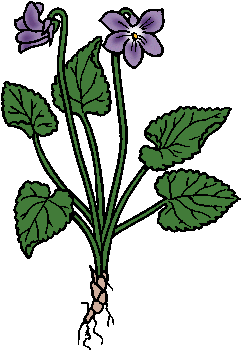
violet

violet

noun

Illustration of violet

Viola

When to Skip Mowing in May If your backyard looks more like a tapestry lawn—patches of violet, yellow, and white mini blossoms—than an uninterrupted blanket of green that resembles a golf course, then No Mow May is for you. — Yelena Moroz Alpert, Architectural Digest, 8 Apr. 2026

trillium

trillium

noun

Illustration of trillium

Trillium

Come in spring when migratory warblers fill the trees and trilliums bloom along the Heron Rookery Trail. — Alexandra Gillespie, AFAR Media, 19 Sep. 2025

goldenrod

goldenrod

noun

Solidago nemoralis, old field goldenrod

Milkweed and moths at screens, fields of corn and goldenrod and Queen Anne’s lace. — Karen Brown, The Atlantic, 31 Aug. 2021

touch-me-not

touch-me-not

noun

Mimosa pudica

The leaves and petals of the touch-me-not have been traditionally used by Korean girls and women to dye their fingernails in the summer, and there’s even a superstition that if there’s still some dye left on your fingernails by the time the first snow falls, then your first love will come true. — Regina Kim, Forbes, 7 Oct. 2024

black-eyed Susan

black-eyed Susan

noun

Rudbeckia hirta

Pick colorful, feel-good plants such as summer coleus and petunia, fall aster and black-eyed Susan, winter’s fragrant golden Mexican orange and camellia sasanqua, and your favorite spring flowers. — oregonlive, 8 Sep. 2021

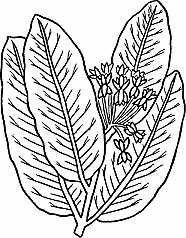
milkweed

milkweed

noun

Illustration of milkweed

Asclepias syriaca seed pods, upper image from August and lower from December

Monarchs rely on one group of plants on which to lay their eggs: the milkweeds. — Molly Marquand, Good Housekeeping, 28 July 2016

lily

lily

noun

small white fawn-lily, white fawn-lily, white trout-lily, tooth-lily

The trail takes visitors along Rottenwood Creek where, at this time of year, thousands of dimpled trout lilies (Erythronium umbilicatum) create bright yellow carpets on the hillsides and stream banks. — Charles Seabrook, AJC.com, 7 Mar. 2026

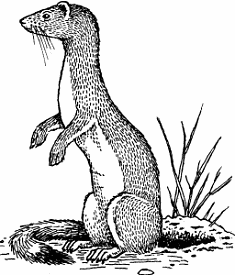
weasel

weasel

noun

Illustration of weasel

Weasel

Weasel

rinse

rinse

verb

rinse out the mouth

I rinsed my face in the sink.

laser

laser

noun

A telescope in the Very Large Telescope system producing four orange laser guide stars

laser beam

laser printer

doctors using a laser to perform delicate eye surgery

maser

maser

noun

A hydrogen maser.

In 1960, physicist Ted Maiman developed the laser by building on its 1950s predecessor, the maser. — John Ballato, The Conversation, 24 Mar. 2026

In fact, observations of these masers have proved that our Milky Way is a magnificent example of a spiral galaxy. — Phil Plait, Scientific American, 20 Feb. 2025

dusk

dusk

noun

The park closes at dusk.

adjective

beginning to grow dusk outside

verb

the dusking room

dissipation

dissipation

noun

Insulation helps prevent the dissipation of heat from houses in the winter.

hippie

hippie

noun

Why are acorn woodpeckers the hippies of the bird world? — Kelcie Pegher, Los Angeles Times, 7 Sep. 2023

But a lot of things were happening in the 60s, like the hippie movement. — National Geographic, 10 Mar. 2018

embodiment

embodiment

noun

Mother Theresa was often regarded as the embodiment of selfless devotion to others.

Nvidia, the leading maker of AI chips, is the embodiment of the AI boom. — Kevin Stankiewicz, CNBC, 22 Jan. 2025

He was once cheered as the embodiment of the Chinese dream. — New York Times, 8 July 2021

confide

confide

verb

He confided that he was very unhappy with his job.

My heart is open to anyone who needs someone to confide in. — Jake Adams, The Courier-Journal, 7 Oct. 2022

Who wants to confide in someone who doesn’t understand you? — Jessica Marie Garcia, refinery29.com, 13 July 2020

reserved

reserved

adjective

She is a very reserved young woman.

The front row is reserved for faculty.

sob

sob

verb

sobbed out her grief

She could not stop sobbing.

“I hate you,” she sobbed.

noun

He’s one arrogant/tough/greedy SOB.

I hate that miserable SOB.

glow

glow

verb

The coals glowed in the fireplace.

This toy glows in the dark.

noun

We could see the glow of the lamp in the window.

Their problems were all forgotten in the glow of victory.

slim

slim

adjective

She looked slim and fit for her age.

verb

She started exercising to slim her thighs.

I’ll skip dessert; I’m slimming.

lovebird

lovebird

noun

Green- and blue-series peach-faced lovebirds

Artemis

Artemis

noun

Artemis

Artemis II

rough

rough

adjective

a rough draft

The design is still a bit rough around the edges. = the design needs refinement

Don’t be so rough on them for the mistake. = don’t criticize or punish them so harshly

we’ve had some rough times

The First Step to Take When You’re Having a Rough Day

unprecedented

unprecedented

adjective

The team has enjoyed unprecedented success this year.

scam

scam

noun

Financial scams and fraud come in many different forms, including text messages, emails, or phone calls, and often these fraudulent communications are designed to look like they are coming from your bank. - TD Bank

brain rot

brain rot

noun

This meme gave me brainrot. - The Brainrot Industrial Complex

As a result of too much screen time, brain rot might be associated with symptoms like brain fog, fatigue, reduced attention span and an inability to self-regulate. — Sarah Jacoby

People are assigning themselves homework to combat brain rot and improve their attention spans. There are no grades and no hard deadlines, just the satisfaction that comes with enriching your mind … — Daniel Wine

Just like teenagers or young adults who can display physical and cognitive signs when they consume an overload of brain rot, so do young children. — Lindsay Freiberger

insolvency

insolvency

noun

inability to pay debts

bankruptcy

unless the economy improves, many resorts in the area face insolvency

This means more retailers may soon be on the brink of insolvency. — Sommer Saadi, Bloomberg.com, 9 Feb. 2023

Youth

by Gwilym Fielden Hughes

People are always talking about ‘the problem of youth’. If there is one – which I take leave to doubt – then it is older people who create it, not the young themselves. Let us get down to fundamentals and agree that the young are after all human beings – people just like their elders. There is only one difference between an old man and a young one: the young man has a glorious future before him and the old one has a splendid future behind him: and maybe that is where the rub is.

When I was a teenager, I felt that I was just young and uncertain – that I was a new boy in a huge school, and I would have been very pleased to be regarded as something so interesting as a problem. For one thing, being a problem gives you a certain identity, and that is one of the things the young are busily engaged in seeking.

I find young people exciting. They have an air of freedom, and they not a dreary commitment to mean ambitions or love of comfort. They are not anxious social climbers, and they have no devotion to material things. All this seems to me to link them with life, and the origins of things. It’s as if they were, in some sense, cosmic beings in violent and lovely contrast with us suburban creatures. All that is in my mind when I meet a young person. He may be conceited, ill-mannered, presumptuous or fatuous, but I do not turn for protection to dreary cliches about respect of elders – as if mere age were a reason for respect. I accept that we are equals, and I will argue with him, as an equal, if I think he is wrong.


  • from BBC radio The Listener(in the Out of the Air series, mid-20th century)
  • Gwilym Fielden Hughes (1899-1989) British Schoolmaster, Writer, Broadcaster and Father of Writer David Hughes.

Children, Sex, and the Media - 3 Ways for Parents to Gain Control

by Nancy Shute

Limiting screen time and talking about what they see are two places to start.

Kids get more sex education from TV, music videos, and the Internet—let’s make that Jersey Shore, 50 Cent, and XXX-rated websites—than they do from their parents and teachers, and that’s not a good thing, according to the nation’s pediatricians. They’re calling on parents to step up and help children learn how to become responsible sexual human beings.

Teens and Sex: How to Help Your Kids Dodge Pregnancy and STDs

Clearly we parents aren’t doing a very good job of that now. The United States boasts the highest rate of teen pregnancies in the developed world, and 25 percent of American teenagers have a sexually transmitted disease (STD). But we parents could really use some help. Many moms and dads shy away from talking about sex with their children. So instead, teenagers learn about sex from TV, where 70 percent of teen shows contain sexual content, and less than 10 percent of those shows give examples of responsible sexual behavior, such as delaying sexual activity or reducing the risk of sexually transmitted diseases, according to a new report on teens, sex, and the media from the American Academy of Pediatrics.

Why Teen Pregnancies Are on the Rise

The AAP is encouraging pediatricians to ask two questions at every well-child visit in order to judge how a child’s media use may be affecting his or her health: whether a child has a TV or computer in the bedroom and the amount of screen time a child takes in daily.

Although those questions may help identify when a child has a problem with media use, dealing with it will be up to the parents. Parents have the most control over their child’s media use, and the biggest potential for positive impact. Here are three recommendations for parents on how to handle sex and the media from Victor Strasburger, lead author of the new report and chief of adolescent medicine at the University of New Mexico School of Medicine:

Limit all screen media time to a maximum of two hours a day. This not only reduces the dose of sexually inappropriate content a child gets daily, but leaves time for other things, like homework, sports, friends, and family.

Get the TV and computer out of children’s bedrooms. Parents can’t know what media children are consuming if their kids are holed up in their rooms. Having a TV in the bedroom is linked to lower grades and higher rates of obesity, too.

Use sex in the media to do on-the-spot sexual education on a regular basis, rather than having one big talk. A parent can watch TV with a teenager and note that sexual relationships don’t work that way in real life, or that the reason the girl with the tight T-shirt is in the commercial is to sell more beer.

That last point may sound terrifying, but Diane Levin, coauthor of the book So Sexy So Soon, says that asking teenagers why they like certain shows or songs can provide a great opportunity to talk about sexual issues in a way that’s fairly comfortable. Parents can watch with a child and point out specific images or acts, and explain why they find those sexual or violent images disturbing or inappropriate. As a result, teenagers gain a better understanding of sex in the real world, as well as of their parent’s ethical and moral standards.

The pediatricians also put in a plea for less sexual imagery on TV, and a ban on ads for erectile dysfunction drugs until after 10 p.m. Good luck on that one, doctors. But it would be nice to not have to try and explain to children why the gray-haired people get all cuddly after popping blue pills.

Tags: sexual health, sex education, media, sex, parenting, children’s health, internet, television


Children, Sex, and the Media: 3 Ways for Parents to Gain Control


显示汉文翻译


My Monthly Digest List - March - 2026

Psychology Today

November/December2025, Volume 58, No. 6

The philosopher of patterns

How we discover the world around us, according to Douglas Hofstadter.

By Tyler Woods

Now 80 and retired after five decades as a professor at the University of Indiana, he’s also turned his focus to a related project he’s been engaged in his entire adult life: ambigrams.

“It’s how we come to understand. Analogy is how we do everything.”

The emerging problem of ‘AI Psychosis’

Chatbots may amplify people’s delusions.

By Marlyn Wei, M.D., J.D.

a paper in preprint, titled “Delusion by design? How everyday AIs might be fueling psychosis(and what can be done about it)” by an interdisciplinary team of researchers

Reader’s Digest

February/March 2026, Large Print

My Heart will go on

A medical journalist’s surprise heart attack reveals how much she didn’t know about the No.1 killer of women - and men

By Melinda Lawrence

The New Yorker, March 23, 2026

The Price of Independence
Who bankrolled the American Revolution?

By Adam Gopnik

“Money makes the world go round,” the cynical old maxim, and Broadway show tune, runs. “Follow the money,” a maxim minted in the film “All the President’s Men,” has become just as familiar.

Canadian Geographic

Martial arts master, Holleywood actor Chuck Norris dies at 86.

The CBC: How Canada’s Public Broadcaster Lost Its Voice (and How it Can Get it Back)

by David Cayley

Preface

This book goes to press at a moment when the election campaign of 2025 is still in progress and its outcome still uncertain. The Conervative Party has pleged to “defund” the CBC, excepting Radio Canada, and its leader, Pierre Poilievre, has even threatened to turn the CBC’s English language headquarters into a hoursing project. The Liberal Party has said it will increase funding to the CBC and “renew” its mandate. Both parties assume they know what the CBC is and what it’s for.

My English Phrases List - March - 2026

How’s it going?

Normal responses

  • Good
  • pretty good
  • Not bad

Enthusiastic responses

  • Great!
  • Fantastic!
  • Everything’s going great!

to drop off

to pick up

to board

to deplane

to check in

to line up

bolt from the blue

That insight, buttressed by the still frames, struck me like a bolt from the blue. — Ahmed Walid, The Athletic, 23 Feb. 2025

scavenger hunt

Complete a scavenger hunt with Milo and Tina, the Olympic and Paralympic Games mascots - Celebrating The Winter Olympics 2026, Waterloo Public Library

wind down

the party was winding down

Trump says he is considering ‘winding down’ Iran war

senior citizen

Those 62 and older can get a free senior citizen ID card. — Jim Radcliffe, Oc Register, 30 May 2025

big picture

Don’t lose sight of the forest - the big picture - for the trees. — The Star-Telegram Editorial Board, star-telegram, 1 May 2018


My English Words List - March - 2026

escalator

escalator

noun

Escalator in a metro station in Warsaw

Elevator and escalator technician These workers install and maintain elevators, escalators and those moving walkways in airports. — Daniel De Visé, USA Today, 27 Feb. 2026

exile

exile

noun

Max Born‘s discovery of quantum mechanics, his family’s extile from Nazi Germany, - The End of the Certain World, by Nancy Thorndike Greenspan

verb

with their conquest of the Moors complete, Ferdinand and Isabella next exiled the Jews from Spain

pitaya

pitaya

noun

commonly known as dragon fruit and strawberry pear

Fresh ripe dragon fruit in Vietnam

Portugal

Portugal

geographical name

Flag of Portugal

flour

flour

noun

corn flour

self-rising flour

flower

flower

noun

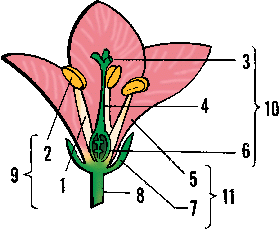
Illustration of flower

1 filament 2 anther 3 stigma
4 style 5 petal 6 ovary
7 sepal 8 pedicel 9 stamen
10 pistil 11 perianth

a hydrangea flower

the flower of our youth

nuisance

nuisance

noun

Weeds are a nuisance to the gardener.

common nuisance

myopia

myopia

noun

Glasses are commonly used to address myopia.

She wears eyeglasses to correct her myopia.

Severe myopia increases the risk of serious eye disease; but myopia treated early can slow its progression. — Brian Park, Mercury News, 24 Feb. 2026

Studies reveal that high levels of screen time are associated with around a 30% higher risk of myopia. And combined with excessive computer use, this increases the risk to around 80%. - Can Too Much Screen Time Cause Myopia?

atropine

atropine

noun

The study also evaluates the efficacy of atropine eye drops in slowing myopia in children. — Oc Register, 9 Sep. 2025

scavenger

scavenger

noun

The scavenger hunt is best for children ages four to 10. — courant.com, 9 Sep. 2021

snarl

snarl

verb

Snow event declared in cities across Waterloo region as winter weather snarls traffic

Multiple collisions and poor weather snarl highways across southern Ontario

noun

traffic snarls

to no avail, the city promotes carpooling to help ease the traffic snarls that always accompany rush hour

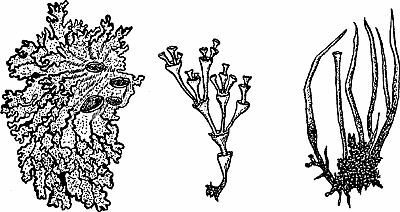
lichen

lichen

noun

Illustration of lichen

A tree covered with leafy foliose lichens and shrubby fruticose lichens

Chickadees and hummingbirds often use spongy moss and lichen as nesting materials. — Madeline Buiano, Martha Stewart, 10 Mar. 2026

plaintiff

plaintiff

noun

If the plaintiff does not appear, the judge or magistrate may dismiss the case. — Tresa Baldas, Detroit Free Press, 22 Aug. 2023

Plaintiff awarded $3M in Los Angeles social media trial -> Why Meta and YouTube lawsuit could trigger the ‘end of social media as we know it’

bro

bro

noun

hanging out with his bros

Hey, bro, what’s up?

Catch you later, bro.

sis

sis

noun

The bride is expected to ask her big sis to serve as her maid of honor. — Caroline Picard, Good Housekeeping, 28 Apr. 2018

strait

strait

noun

The Strait of Hormuz is a waterway between the Persian Gulf and the Gulf of Oman.

chin-up

chin-up

noun

  • such an exercise done with the palms facing inward

pull-up

pull-up

noun

  • specifically : such an exercise done with the palms facing outward

A U.S. marine performing a pull-up

push-up

push-up

noun

A U.S. Army servicemember demonstrates a one-arm push-up in an extended position.

Why is English so confusing? - Arika Okrent

It was June 2010. Inside the Scripps National Spelling Bee, contestants between 8- and 15-years-old wrestled words like brachydactylous and leguleian. Outside, a crowd protested the complexity of English spelling conventions. Indeed, spelling reformers have been around for centuries, advocating for overarching changes to make English spelling more intuitive. The English language is chock-full of irregularities. One commonly used example of this: take the “g-h” sound from “enough,” the “o” sound from “women,” and the “t-i” sound from “action,” and you could argue that “g-h-o-t-i” spells “fish.” So, how did English get like this?

English arose from old Germanic tribes that invaded the British Isles more than 1,500 years ago. Their languages coalesced and evolved into Old English. When Roman missionaries arrived around 600 CE, they devised ways to write it down using the Latin alphabet, supplementing it with some Germanic runes for sounds they didn’t have letters for.

Then came the Norman invasion of 1066 when French speakers conquered England. French became the language of authority and high society. But English remained the dominant spoken language. Over time, those descended from French speakers also became English speakers, but some French words snuck into the language. Some English speakers were also familiar with Latin through the church and formal education. By the mid-1400s, people were writing in English again — but it was unstandardized. They used a mix of influences to determine word choice and spelling, including the French they knew, the Latin they studied, and the English they spoke.

So, things were already pretty messy. Then, in 1476, the printing press arrived in England. Some of the people working the presses may have mainly spoken Flemish — not English. And they were given manuscripts that varied widely in their spelling. Without standardization, different writers went with various spellings based in part on what they happened to encounter while reading.

Many words had a multitude of spellings. The word “dough,” for instance, used to be spelled in all these ways and was originally pronounced “dach.” The guttural Germanic sound it ended with was one the Latin alphabet didn’t cover. It eventually came to be represented with “g-h.” But, for some “g-h” words, English speakers eventually dropped the guttural sound altogether; for others, they ended up pronouncing it as “f” instead, as exemplified in “dough” versus “tough.” Printing presses memorialized the spelling even though the pronunciation eventually changed. And this wasn’t just the case with “g-h.” Some letters in other words also fell silent: words like knife, gnat, and wrong all contain the vestiges of past pronunciations.

But while the printing press was solidifying spellings, the English language was also undergoing what scholars call the Great Vowel Shift. Between the 14th and 18th centuries, the way English speakers pronounced many vowels changed significantly. For instance, “bawt” became “boat.” This displaced the word for “boot,” which had up until then been pronounced “boat,” and pushed it into the high “u” vowel position it maintains today. Words that already had this high “u” often became diphthongs, with two vowels in a single syllable. So, “hus” became “house.” As with so many linguistic matters, there’s no clear reason why this happened. But it did. And how the vowel shift affected a word depended on various things, including the other sounds in the word.

The word “tough” was once “tōh,” among other variations. “Through” was once “thruch” and “dough” “dah.” These words all started with different vowel sounds that were then affected differently by the vowel shift. The “o-u” spelling they all adopted was a haphazardly applied French influence. So, eventually they wound up with still distinct vowel sounds, but similar spellings that don’t really make much sense.

All this means English can be a difficult language for non-native speakers to learn. And it reveals the many ways history, in all its messiness, acted upon English, making it especially tough.